
Achievements
COPL has made its mark nationally and internationally as a leading research center in optics and photonics.
The results of the work carried out by its faculty members are the subject of an average of 456 publications per year, 68% of which are published in journals ranked in the top 25% of high-impact journals, according to the SNIP journal performance indicator.
On average, these publications are more highly cited than comparable publications in their fields. Between 2018 and 2021, the group’s “Article” publications as a whole received an average of 63% more citations than the global average in their fields.
At the same time, almost 50% of the publications by the group’s researchers, published since 2018, have come from international collaborations, and 538 publications have been produced in collaboration with COPL members. Collectively, they receive around 26,000 citations per year, a fine indication of the influence of the research taking place at COPL.
A key player in the innovation chain, COPL is also very active in the startup ecosystem. In fact, entrepreneurship is one of the hallmarks of the cluster’s organizational culture. In less than 10 years, our members have contributed to the creation of just over 20 spin-off companies.
Here are just a few of the scientific and technological achievements coming out of the labs.
Scientific and technological advances

François Légaré
Capturing chemical reactions at the molecular scale in real time, revealing the roaming trajectories of certain molecular fragments
This scientific breakthrough by researchers Heide Ibrahim and François Légaré, both from INRS, was named one of Québec Science’s 10 discoveries of the year for 2021.

Frédéric Leblond
Raman spectroscopy as a rapid detection tool for SARS-CoV-2
Raman spectroscopy as a rapid detection tool for SARS-CoV-2, the virus that causes COVID-19 — that’s what postdoctoral fellow Katherine Ember and Professor Frédéric Leblond of Polytechnique Montréal are proposing.

Frédéric Leblond
Anti-cancer probe
The probe developed by Frédéric Leblond (Polytechnique Montréal) and his colleague, oncological neurosurgeon Kevin Petrecca, was named one of Québec Science magazine’s top 10 discoveries of 2017. This pencil-sized tool can detect cancer cells in real time during brain surgery — cells that were previously undetectable.
Tigran Galstian
Smart lens
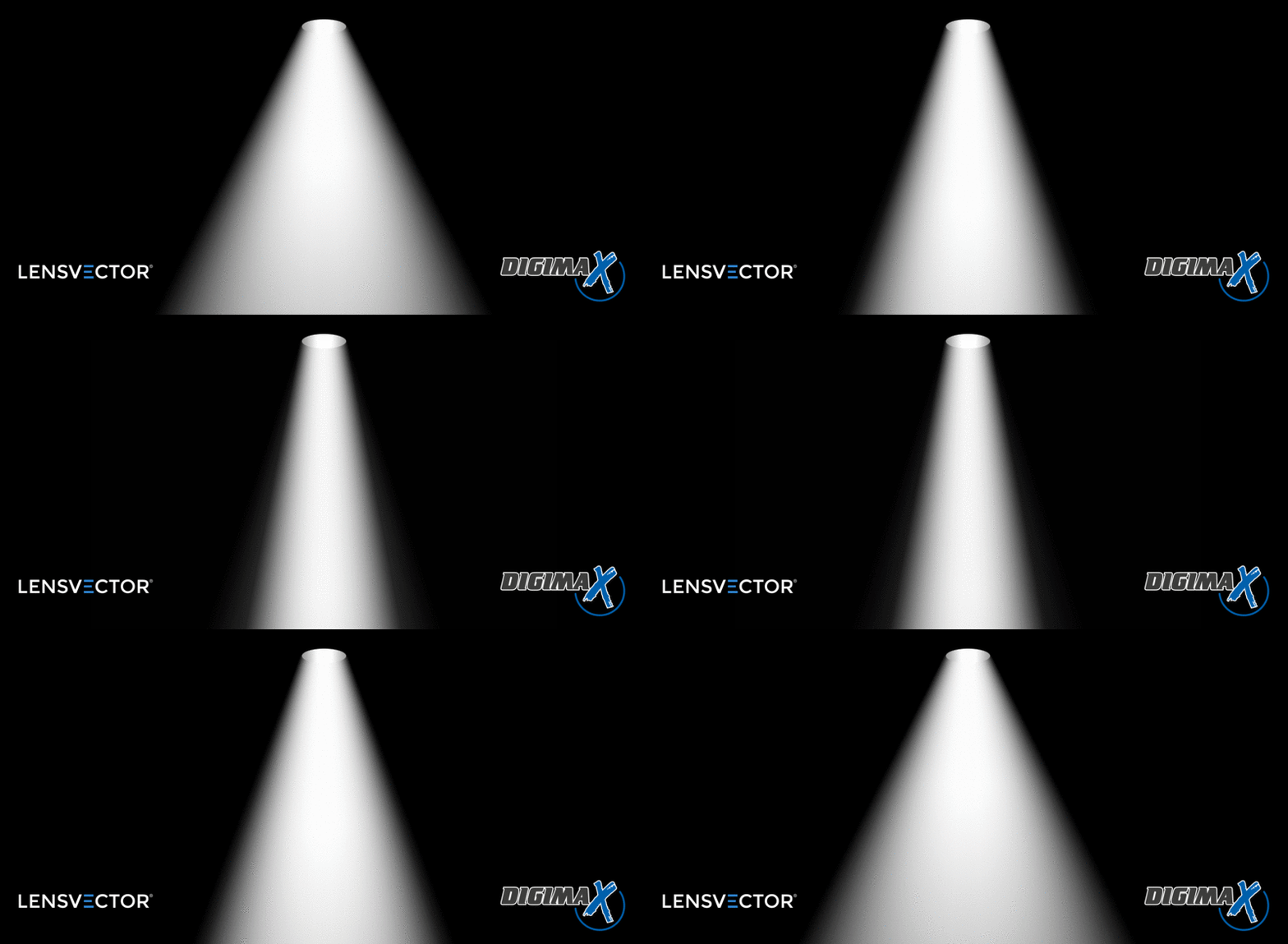
Developed under the direction of Tigran Galstian (Université Laval) and based on liquid crystal technology, the lens can be integrated into light fixtures and can focus LED light from a smartphone.

Photo: Samuel Beaulieu
François Légaré
Photoionization of chiral molecules
Work carried out in François Légaré’s laboratories at INRS on molecular chirality made it possible to observe, at the attosecond scale, the changes that occur in the chemical properties of molecules when they are struck by a laser beam emitting attosecond-scale pulses. This scientific breakthrough was ranked among the top 10 discoveries of 2018.

Crédits © Michael Kues, INRS
Roberto Morandotti , Jose Azana
On-chip generation of high-dimensional entangled quantum states
Optical quantum states based on entangled photons are essential for addressing questions in fundamental physics and are at the heart of quantum information science. A team led by Roberto Morandotti and José Azaña of INRS achieved a breakthrough in quantum photonics using on-chip devices and commercially available telecommunications components. The team demonstrated that photons can become an accessible and powerful quantum resource when generated as entangled quDits across a color spectrum.

Pablo Bianucci
Selective growth of zinc oxide nanorods
Covered by numerous science-outreach media outlets around the world, this achievement from Pablo Bianucci’s laboratory at Concordia University demonstrates the potential of zinc oxide nanorods for developing: new, low-cost, more efficient optical sensors for gas detection; more efficient solar panels; and low-cost hydrogen fuel cells.
Réal Vallée , Younès Messaddeq
Low-loss 3D waveguide writing for the fabrication of compact integrated photonic circuits
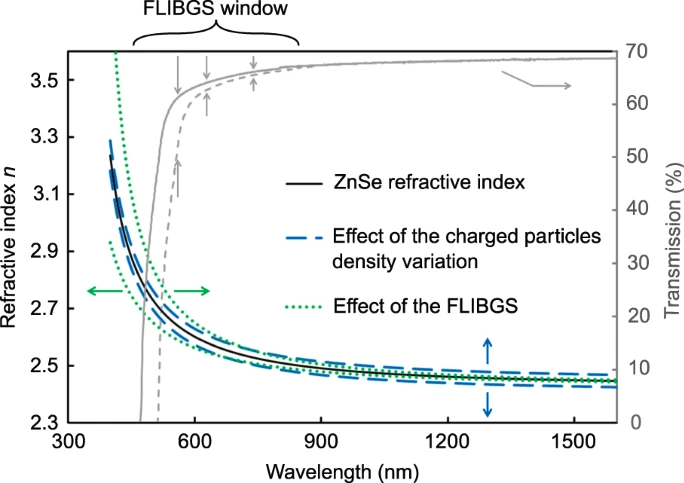
By using femtosecond lasers to trigger bandgap shifts inside crystals and glasses, a COPL team observed nanoscopic changes favorable to writing 3D waveguides with micrometric bend radii that can be used to direct light while minimizing energy loss. Previously, the smallest bend radii achieved for three-dimensionally fabricated waveguides were on the order of 10 mm. This technological advance, achieved by Jérôme Lapointe in collaboration with colleagues from Réal Vallée’s and Younès Messaddeq’s research teams (Université Laval), paves the way for unprecedented miniaturization of highly sought-after photonic and quantum circuits.
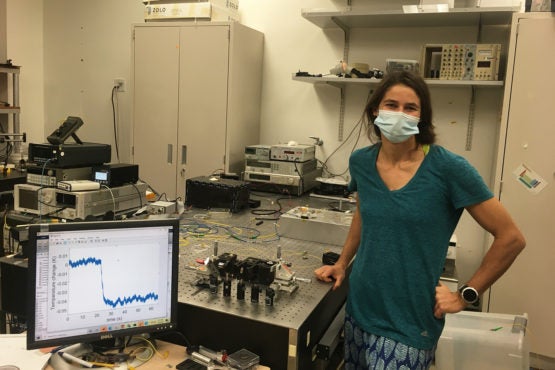
Image credit: Pierre Baptiste Vigneron
Martin Bernier
Laser cooling of silica optical fiber
For years, researchers had worked unsuccessfully to develop a silica optical fiber capable of self-cooling under laser irradiation. Such a fiber would pave the way for high-power lasers that require no cooling, as well as for the development of laser devices with exceptionally pure and stable frequencies.
Collaborative work carried out over nearly a decade by Prof Martin Bernier from Université Laval with Prof Michel Digonnet of Stanford University in California has indeed led to the development of the first self-cooling silica fiber — a major step forward toward practical applications.

François Légaré
Observation of roaming molecular fragments during a chemical reaction
A team from François Légaré’s laboratory at INRS observed roaming hydrogen fragments orbiting around an HCO fragment during a chemical reaction. The images were captured at the femtosecond scale.
Roberto Morandotti
Accelerator for neural networks
An international team that included Roberto Morandotti (INRS) developed an optical neural network capable of recognizing and processing large-scale data and images at ultra-high computing speeds — beyond ten thousand billion operations per second.

Paul Charette
World’s first high-resolution infrared camera for non-military markets
Leading a multi-institutional team of 7 researchers, Paul Charette (Université de Sherbrooke) directed the development of the world’s first high-resolution infrared camera for non-military markets. This achievement is now commercialized by an industrial partner.